Habit Tracking- 5 Week Reflection
My Experience Habit Tracking
I’ve been habit tracking for over five weeks now, and it has been incredibly helpful for me. I’ve always been someone that struggled with energy, motivation, and mood in the winter months when everything is really dark and cold. This year was no different. Also, I was starting grad school which has proven to be a really big commitment. I’m in a very intense program that demands a lot of my time. Additionally, I have always been someone who struggles with focus, attention, and time blindness. Especially with starting school again and running my business, I wanted to set myself up for success and strengthen some foundational habits. I knew that I wanted to find a system that worked for me and that I could use for motivation.
I’m not new to habit tracking, I’ve done research in undergrad on the topic and I have habit tracked many times before. I’ve tried the 75 soft challenge, I’ve made complicated Notion dashboards, I’ve tried various apps and programs, etc. However, I found that none of them stuck. I wasn’t able to continue with these systems, because they were overly complicated and the barrier of entry was too high. Or, something on my computer or phone, provided far too many distractions for it to be sustainable. Especially in a time where everything we do is on devices, myself and many other people want to reduce screentime. When your habit tracker is on a screen, it’s counterproductive. Another issue I encountered was that many habit trackers are only for daily use. There are certain habits I don’t necessarily need to do every day. I wanted a habit tracker that allowed for this.
In this blog post, I want to tell you a little bit about my experience of habit tracking and how I designed a system that works for me. Throughout this “project” I’ve made it a priority to journal almost every day, so I do have plenty of thoughts written down. I plan on doing a more comprehensive overview and reflection in the future, maybe when I reach 10 weeks of habit tracking.
What habits did I set for myself?
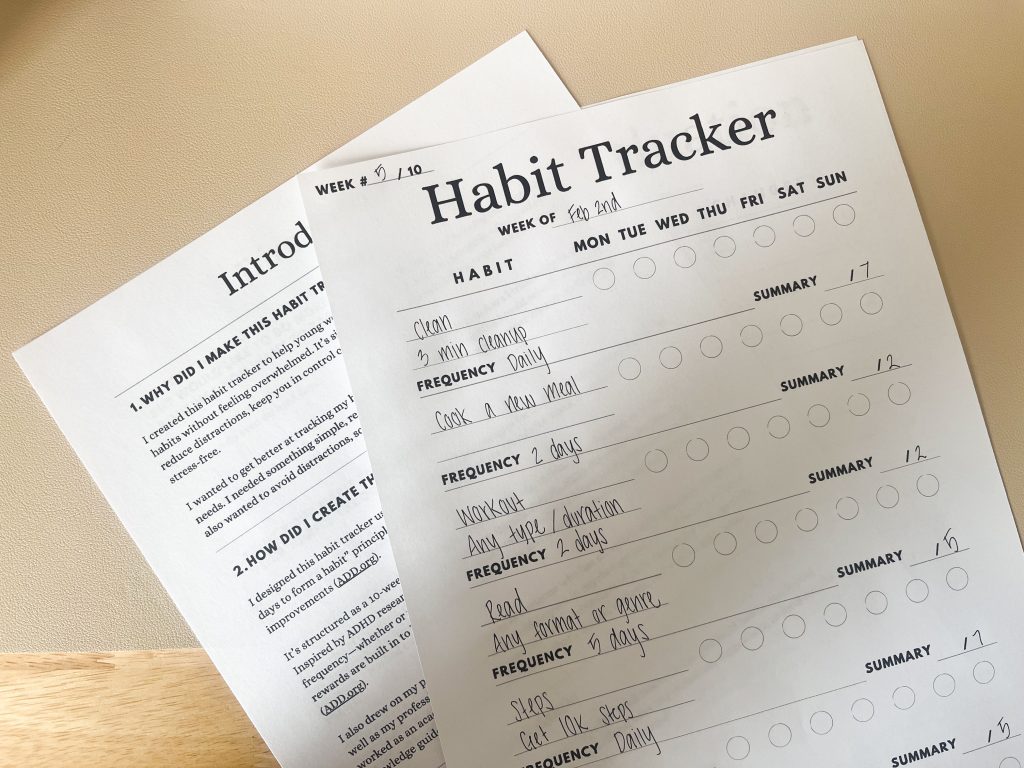
- Clean for 3 minutes each day
- Cook a more involved meal 2 days of the week: “more involved” meaning I learned something from it or tried something new
- Read any genre, any amount, any format 5 days of the week
- 10k Steps every day: This is not a new habit for me. I’ve been doing this for over 7 years now, it’s just something I want to deliberately continue doing
- Journal any amount 5 days of the week
- Workout any type, any location, any length 2 days of the week
A few things I have noticed since habit tracking for 5 weeks:
- I have been writing things down more in general.
- Journaling was hard for me at first, but now I have plenty of ideas.
- I’m much more aware of my body, likely from lifting weights more consistently.
- I’m reading every day, but not reading more books. I haven’t even finished one book since starting this. This one surprised me.
- I’m remembering more from the book I’m reading.
- I’m getting much more comfortable cooking, especially with making substitutions.
- Making bowls is my favorite type of meal to make.
- My space is noticeably cleaner.
- I have more motivation to clean.
- I’ve been taking one small area (bathroom counter, kitchen counter, my desk, etc.) and focusing on that rather than a whole room.
What is the system I created?
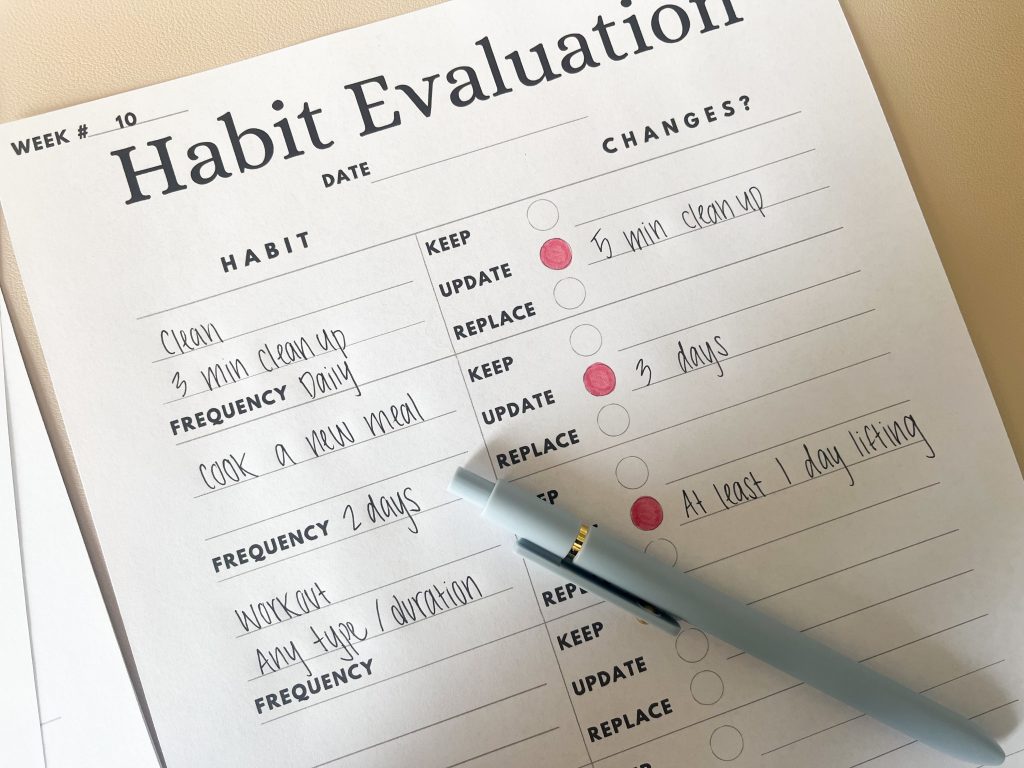
I designed a simple habit tracker that can be printed and reused each week. The system includes the habit tracker page, a habit evaluation page, an introduction, and directions. At the end of each week, you are also reminded to reward yourself. Just by tracking your habits consistently, you are gaining awareness of your own time and learning about yourself. After 10 weeks, you are asked to evaluate your habits and build upon them.
It’s structured as a 10-week course with numbered sheets, making progress easy to follow. Inspired by ADHD research on time blindness (Morrison et al., 2022), the tracker focuses on frequency—whether or not a habit was done—rather than counting specific amounts. Small rewards are built in to help reinforce consistency and make habit-building feel achievable(ADD.org).
How did I create the system I’m using?
I also drew on my personal experience as someone who has struggled with focus and ADHD, as well as my professional background: I hold degrees in psychology and neuroscience and have worked as an academic coach and teacher. This combination of personal insight and scientific knowledge guided the creation of a system that’s simple, realistic, and easy to stick with.
I designed this habit tracker using research-backed strategies for building habits, including the “66 days to form ahabit” principle(Lally et al., 2009) and the 1% rule for small, consistent improvements(ADD.org).
Future Plans and Link
I plan to update this blog after I’ve been habit tracking for longer, and provide a more detailed recount of my experience. I also would like to make graphs and show some examples of the data I’ve been able to collect from this experience.
I created this habit tracker to help young women with ADHD or trouble focusing build lasting habits without feeling overwhelmed. It’s simple, science-backed, and printable—designed to reduce distractions, keep you in control of your time, and make tracking your habits easy and stress-free. I hope that the habit tracker can help you achieve your goals too!
If you are interested in the habit tracker, I have it available on my Etsy.